
Introduction
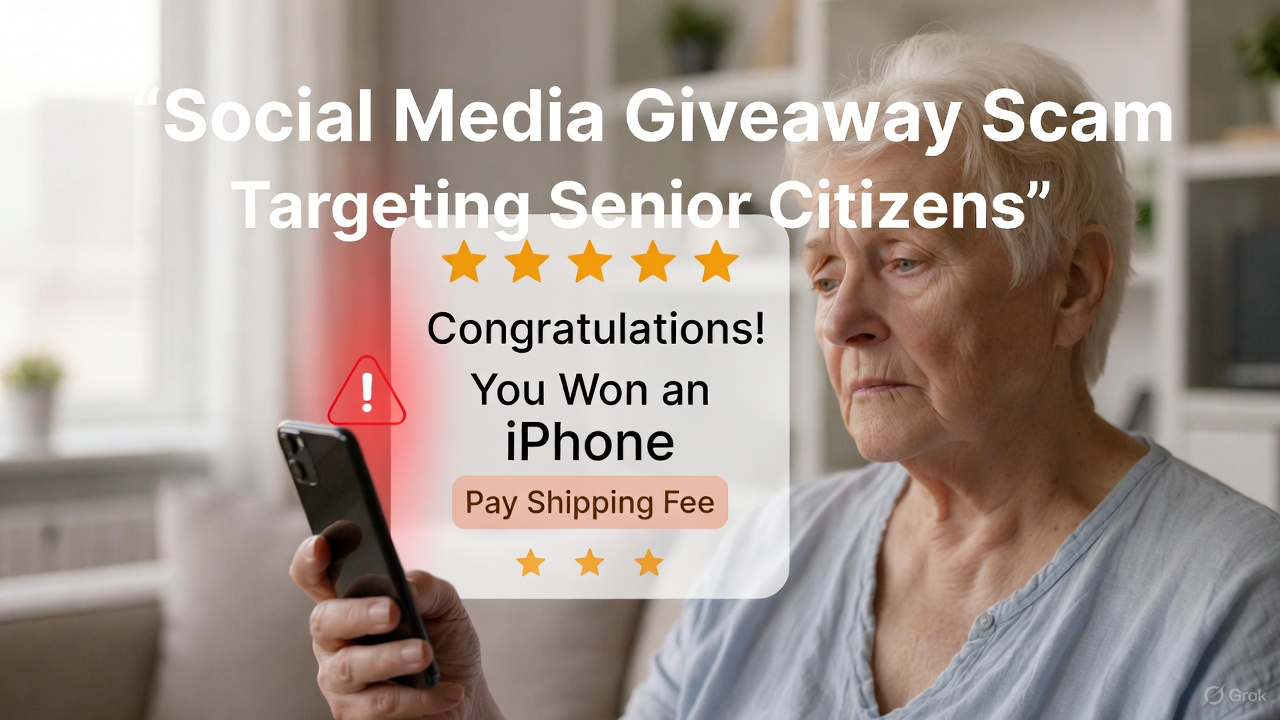
Learn how “Social Media Giveaway Scam Targeting Senior Citizens ” in 2026 and discover simple steps to stay safe from online fraud.
Have you ever seen “You Won an iPhone” or any other type of message or have you not noticed that this can also be a scam and know how senior citizens are being targeted in social media giveaway scams in 2026 and how they can keep themselves safe, in this blog I will tell you in very simple language how you can identify this scam and save yourself and your people, so let’s start this blog and if you have any doubt then you can send me a message now.

“Congratulations! You Won an iPhone!” — Or Did You?
Imagine this.
You’re quietly scrolling through Facebook, Instagram, or another social media platform after dinner. Perhaps looking at family photos. Perhaps watching devotional videos. And then…
You get a message on your phone.

“🎉 Congratulations! You have won an iPhone 16 Pro Max!
Kindly pay ₹2,499 shipping fee to receive your prize.”
You pause…You think…

“Did I participate in a contest or something? I don’t understand.”
Okay.
“Well, it could also be that I participated in a contest, followed a big critter, or maybe my grandson did.”

Welcome to one of the fastest-growing online frauds in 2026—social media giveaway scam targeting senior citizens.
Why Senior Citizens Are Targeted in Online Giveaway Scams
Scammers aren’t random. They target people deliberately.
Senior adults are often targeted because:
- Many are new to Instagram and Facebook.
- They easily trust messages that appear official.
- They may not check usernames carefully.
- They think “verified” means safe.
- They tend to be polite and respond politely.
Scammers know this, and they take advantage of it.
That’s why fake iPhone giveaway scams targeting seniors are on the rise.
Protect your debit and credit cards from digital theft by blocking unauthorized RFID scans.




What Is a Social Media Giveaway Scam?

Let’s make it very simple.
A. fraudster:
- Creates a fake account pretending to be Apple, Amazon, or a celebrity.
- Sends you a message saying you won a prize.
- Asks for “shipping fee” or “processing charge.”
- Takes your money.
- Disappears.
B. And remember, scammers can sometimes do things like:
- Stealing bank details
- Requesting OTPs
- Sending fake links
- Hacking social media accounts
This is how senior citizens lose money in giveaway scams in 2026.
The 5 Biggest Red Flags Seniors Must Never Ignore

Let’s keep this practical.
❌ 1. If you haven’t participated in a contest
- you can’t win.
- It’s a simple fact: you can’t get anything for free. If you’re getting something for free, it’s harmful and a scam.
❌ 2. They Ask for Money to Claim Prize
- Real companies or real creators who run actual giveaways don’t charge shipping fees for prizes.
- If someone says:
“Pay first to receive your prize.”
- This is a 100% scam.
❌ 3. Urgency Pressure
- Scammers love drama. And you can relate to this:
“Respond within 10 minutes or the offer will be canceled.”
- Why do scammers rush?
- Because they don’t want you to think.
❌ 4. Suspicious Username
Real brand:
@apple
Fake account:
@apple_winner_2026_official_global
- One extra word can cost thousands of rupees.
- Always check carefully.
❌ 5. They Ask for OTP
- This is the biggest danger. You’re smart, my friend.
- OTP = One-Time Password.
If you share it, they can access your bank or account. - Never share your OTP. Not even once. Always remember this.
USB Data Blocker Adapter
Safely charge your phone in public places while completely blocking data transfer to prevent hacking.


How Seniors Lose Money Step-by-Step

Here’s how scammers trap victims:
- Exciting message received
- Emotional reaction (“Wow, I won!”)
- Small payment requested
- Payment sent
- Another payment requested
- Money gone
Sometimes it starts with ₹1,999.
Then ₹4,999.
Then ₹10,000. Then Game over
Real Example (That Happens Every Day)
- Mr. Verma, 68, received a message:
- “You have been selected for Samsung lucky draw.”
- They asked for ₹2,500 shipping fee.
- He almost paid.
- But he called his daughter first.
- She checked the profile. It was fake.
- Money saved.
- One phone call prevented loss.
Why Seniors Should Never Feel Embarrassed

Important point.
- Many senior citizens feel embarrassed after being scammed.
- Please don’t do this. It’s not your fault. You can be cautious about these scams in the future.
Scammers:
- Use professional scripts
- Use AI-generated messages
- Copy official logos
- Design fake websites
“Even educated professionals fall victim.”
- This is not about intelligence.
- It is about awareness.
How Seniors Can Protect Themselves from Giveaway Scams

Let’s make it extremely easy.
✅ Rule 1: Never Pay to Receive a Prize
- If money is required → Stop immediately.
✅ Rule 2: Always Ask a Family Member
- Before sending any online payment:
- Call your son, daughter, or grandchild.
- Two minutes of verification can save thousands.
✅ Rule 3: Do Not Click Unknown Links
Unknown links can:
- Steal passwords
- Install harmful software
- Capture banking information
If unsure, do not click.
✅ Rule 4: Visit Official Website Directly
Instead of replying to message:
- Open browser.
- Search official company website.
- Check if contest is real.
✅ Rule 5: Enable Two-Factor Authentication
This adds extra protection to:
- Banking apps
Even if password is stolen, account stays protected.
How Family Members Can Help Protect Seniors

If you’re reading this blog and you’re younger:
Help your parents and senior citizens:
- Tell them about common scams
- Check suspicious messages
- Install basic security apps
- Encourage them to ask before making payments
“Just as they protected you from all the problems you faced as a child, you too must protect them from these kinds of digital scams.”
What To Do If Money Is Already Sent

Do not panic.
Immediately:
-
Call your bank
-
Block your debit/credit card
-
Report the account on social media
- File cyber complaint
“The faster you report, the better chance of recovery.”
Are Social Media Giveaway Scams Increasing in 2026?
Yes.
Because scammers now use:
- Artificial intelligence
- Fake verified badges
- Professional-looking profiles
- Automated messages
This makes social media scams targeting elderly people harder to detect.
But not impossible to stop.
Awareness defeats technology.
Quick Safety Checklist for Senior Citizens
Before believing any online prize message, ask:
✔ Did I enter the contest?
✔ Are they asking for money?
✔ Does the username look official?
✔ Have I verified from official website?
✔ Did I ask someone I trust?
If any answer is “No” or “I’m not sure” → Do not proceed.
Final Advice
Winning a free iPhone sounds like fun to my brother…
But protecting your retirement savings is more important.
No online gift is worth:
- Pension money
- Hard-earned savings
- Peace of mind
Scammers work fast.
You better act wisely.
Stop. Verify. Stay safe. And follow your brother’s blog and don’t forget to share it with others, so others can find out.
Also read: How Teenagers & Students Are Targeted by Giveaway Scams
Frequently Asked Questions (FAQ)

- Why are seniors targeted in social media giveaway scams?
Because scammers assume seniors are more trusting and less familiar with online fraud tactics.
- Do real companies charge shipping fees for prizes?
No. Legitimate companies do not ask winners to pay money to claim rewards.
- What is the safest action if unsure about a giveaway message?
Pause and consult a trusted family member before taking any action.
- Can fake accounts look verified?
Yes. Scammers can copy logos, usernames, and even create realistic profiles.
- How can senior citizens improve digital safety in 2026?
By learning basic online safety rules, enabling two-factor authentication, and verifying before making payments.
Conclusion
In 2026, scams are smarter.
But senior citizens can be smarter too.
If you receive a “You Won” message:
- Pause.
- Think.
- Verify.
- Ask someone.
- Never pay blindly.
“Your experience and wisdom are stronger than any scam.”