
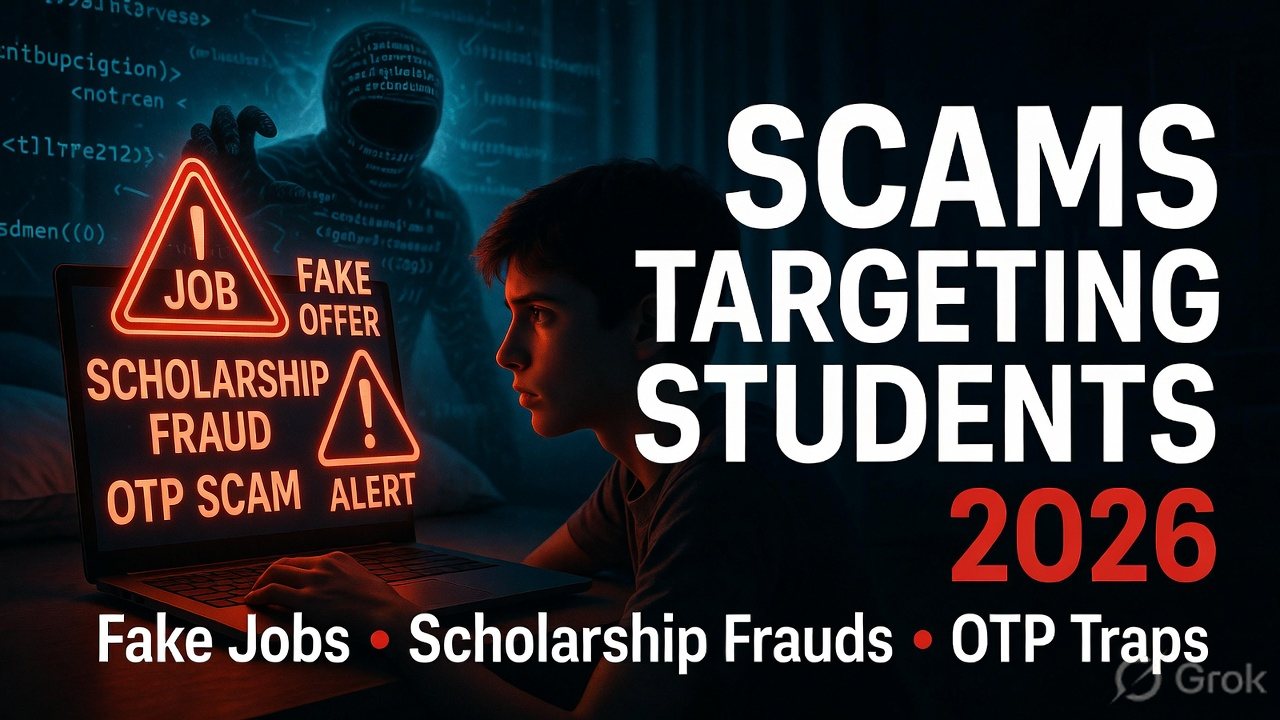
Introduction: Why College Students Are Prime Targets in 2026
In 2026, cybercrime isn’t just about hacking systems—now it’s about hacking people. You understand what I’m saying, friend.
Social engineering scams targeting college students in 2026 have increased significantly because students are digitally active and lack financial experience, and scammers are constantly looking for opportunities. They’re using fake internship offers, scholarship emails, and OTP fraud calls to exploit their highest levels of ambition, urgency, and trust.
Whether you’re applying for your first job, searching for a scholarship, or managing online payments for the first time, you become a high-value target for scammers.
I’ll explain how these scams work, real data-based evidence, the psychological tricks scammers use, and most importantly, how to protect yourself. Let’s move on.
What Are Social Engineering Scams?
Social engineering scams are fraudulent schemes in which criminals trick people into revealing sensitive information, such as passwords, OTPs, bank details, or personal data. They communicate with people pretending to be a verified person.
Scammers use various methods to target college students, including promising jobs or scholarships. VIDEO

According to the Federal Bureau of Investigation (FBI) Internet Crime Complaint Center (IC3) Annual Report, social engineering tactics such as phishing and impersonation remain among the top reported cybercrimes globally.
Similarly, the Federal Trade Commission (FTC) reports that young adults aged 18–29 are increasingly losing money to online scams—especially job and investment fraud.
These scams rely on:
- Trust
- Urgency
- Fear
- Authority
- Rewards
And college students are especially sensitive to these triggers. Or fall into the trap.
Why College Students Are Easy Targets in 2026
Why scammers specifically target students:
1. Job Search Pressure
Students actively apply for internships and remote jobs, making them vulnerable to fake recruiter emails. Unemployment is at its peak, as you understand it, not in all countries but in many. But this is not a reason either. What are your thoughts on this?
2. Scholarship Dependency
Many students rely on financial aid—scammers exploit this through fake scholarship portals. Or, you all know what could happen next.
3. Heavy Social Media Usage
LinkedIn, Instagram, Telegram, and WhatsApp are common scam platforms.
4. OTP Ignorance
Many students still don’t understand that sharing their OTP can empty their bank account in seconds. OTPs are the most important thing these days; if you give them an OTP, it’s game over, son.
5. First-Time Financial Independence
New debit cards, online banking, UPI, PayPal — without proper cybersecurity awareness.
According to data published by the Federal Trade Commission, young adults report losing money more often to job scams compared to older age groups.
Trusted Hardware Security Key
Prevents account hacking even if password is stolen (protects against phishing & fake login scams).

Targus Privacy Screen Filter (Laptop)
Protects the screen from shoulder surfing in college, libraries, and public places.

Types of Social Engineering Scams Targeting College Students in 2026
1. Fake Job Offer Scams
Would you believe me if I said this was the most dangerous scam targeting students right now?
How It Works:
- You receive an email or LinkedIn message from a “recruiter.”
- You’re offered a high-paying remote job.
- No real interview.
- They ask for a “processing fee” or “training kit payment.”
- Or they send a fake check and ask you to transfer part of it.
Red Flags:
- Gmail/Yahoo email domain instead of a company domain.
- Urgent joining deadline.
- No official website verification.
- Asking for payment upfront.
The Federal Bureau of Investigation has repeatedly warned about employment scams increasing among students and fresh graduates.
2. Scholarship Fraud Scams
How It Works:
- Fake government scholarship email.
- The message claims, “You have been selected.”
- Asks for processing charges.
- Collects bank details and identity documents.
Red Flags:
- Grammar mistakes.
- Random links.
- No official government domain.
- Upfront fee demand.
The Federal Trade Commission warns that legitimate scholarships never demand upfront fees.
3. OTP Trap Scams
One of the fastest-growing scams in 2026.
How It Works:
- A scammer pretends to be bank staff or payment support.
- It says suspicious activity was detected.
- Sends OTP to your phone.
- Asks you to “confirm” the OTP.
As soon as you share it, your account is hacked. And your money could be stolen, and you won’t even know how it happened.
4. Fake Internship & Remote Task Scams
- “Earn $500 per day liking videos.”
- “Paid data entry job.”
- “Crypto review internship.”
These scams first pay small amounts to build trust—then demand larger deposits.
5. College Admin Impersonation (Phishing)
Scammers send emails that look like official university notices; you assume it’s an official university notice and provide all the details the scammer demands.
- “Update your student portal.”
- “Exam schedule change.”
- “Library fine pending.”
Psychological Tricks Used by Scammers
for Social Engineering Scams Targeting College Students in 2026
Social engineering scams work because they manipulate human psychology.
Authority Bias
Pretending to be HR, a bank officer, or a professor.
Urgency
“Reply within 30 minutes.”
Fear
“Your account will be blocked.”
Reward
“You won a scholarship.”
Scarcity
“Only 3 internship spots left.”
The Europol cybercrime threat reports confirm that emotional manipulation remains the top driver of phishing success.
Password Manager Premium Subscription (NordPass / LastPass Gift Card)
Stores strong passwords securely and prevents reuse of weak passwords.

Real Data & Proof (2024–2026 Reports)
According to the Federal Bureau of Investigation IC3 report:
- Billions of dollars lost annually to online scams.
- Employment scams rank among top reported fraud categories.
The Federal Trade Commission reports:
- Young adults (18–29) are more likely to report losing money in job scams.
- Social media is the fastest-growing scam contact method.
The Indian Computer Emergency Response Team advisory highlights the following:
- Rising OTP frauds targeting students.
- Fake KYC and scholarship phishing campaigns.
- These aren’t isolated cases — this is a global pattern.
FBI IC3 report (2024 losses): https://www.fbi.gov/news/press-releases/fbi-releases-annual-internet-crime-report
FTC fraud and job scam data: https://www.ftc.gov/news-events/news/press-releases/2025/03/new-ftc-data-show-big-jump-reported-losses-fraud-125-billion-2024
FTC top scams 2024 (job/social media): https://consumer.ftc.gov/consumer-alerts/2025/03/top-scams-2024
CERT-In phishing advisory (India): https://www.cert-in.org.in/s2cMainServlet?VLCODE=CIAD-2024-0050&pageid=PUBVLNOTES02
AARP/Javelin fraud loss report – shows identity fraud & scam losses in U.S. adults: https://www.aarp.org/money/scams-fraud/javelin-identity-theft-report-2024/
Pew Research on online scams by age group: https://www.pewresearch.org/internet/2025/07/31/online-scams-and-attacks-in-america-today/
Warning Signs Checklist
If you see any of these, STOP:
- Asking for payment to get a job.
- Asking for OTP.
- Asking for full bank details.
- Random scholarship congratulations.
- Poor grammar in official emails.
- Unverified domain links.
- Telegram-only communication.
Laptop Webcam Cover Slider
Prevents hackers from spying through webcam after phishing attacks.

How College Students Can Protect Themselves in 2026
- Never Share OTP: Not even with bank staff.
- Enable Two-Factor Authentication (2FA): For email, LinkedIn, and bank apps.
- Verify Job Offers: Check the official company website. Call HR from an official number.
- Check Scholarship Domains: Use only official government portals.
- Avoid Upfront Payments: Real jobs don’t charge joining fees.
- Use Strong Passwords: Use a password manager.
- Report Suspicious Emails: Use official cybercrime portals.
What To Do If You Already Got Scammed
- Immediately call your bank.
- Freeze debit/credit cards.
- Change passwords.
- File complaint on:
- FBI IC3 (USA)
- FTC fraud report portal
- National Cyber Crime Portal (India)
5. Inform your college IT department.
Guide for Parents & Colleges
- Conduct cybersecurity awareness workshops.
- Teach OTP rules.
- Create official job verification boards.
- Share real scam examples during orientation.
Prevention is cheaper than recovery.
RFID Blocking Wallet (Student Version)
Protects debit/credit cards from digital skimming theft.

Frequently Asked Questions (FAQ)
What is a social engineering scam?
A fraud where attackers manipulate people into revealing sensitive information.
Why are college students targeted?
Because they are job seekers, scholarship applicants, and digitally active.
Are fake job offers common in 2026?
Yes, employment scams are among the fastest-growing fraud categories.
Can OTP scams empty your bank account?
Yes. OTP is the final authorization key for transactions.
How can I verify a scholarship email?
Check the official domain, call the institution, and never pay upfront.