
Introduction
Discover how artificial intelligence helps Find Out Climate Change In 2025 With AI Tools . Explore top AI tools, machine learning models, climate data analysis, and real-time weather forecasting powered by AI. Learn how AI fights global warming and tracks environmental changes effectively.
Find Out Climate Change In 2025 With AI Tools
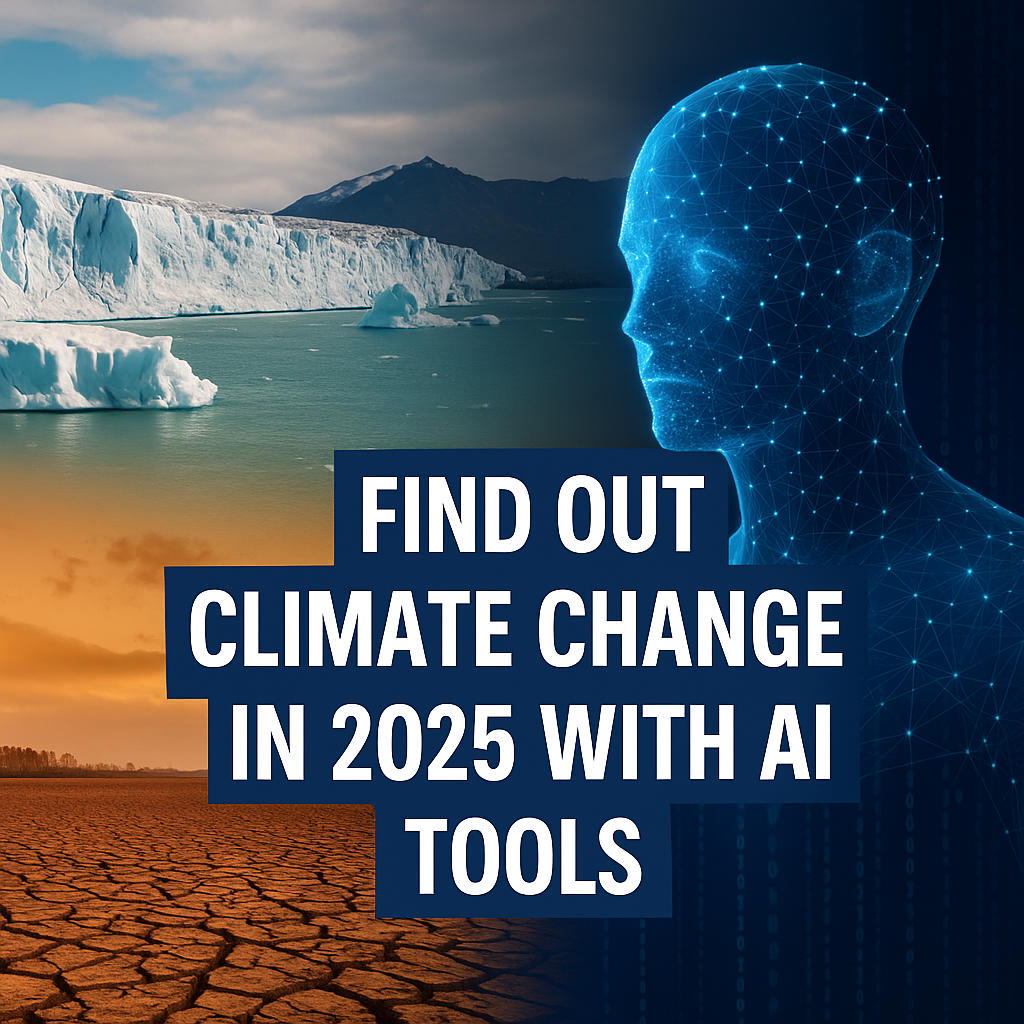
In 2025, climate change is no longer a distant threat — it’s a reality. Melting glaciers, extreme weather, rising sea levels, and increasing global temperatures are clear signs. But the good news is: we now have AI tools that can help us detect, predict, and even fight climate change like never before.
What is Climate Change Detection with AI?
AI-powered climate detection means using:
- Machine learning models
- Computer vision
- Predictive analytics
- Big climate datasets
…to analyze and forecast real-time environmental changes, carbon emissions, and weather patterns.
AI helps researchers identify patterns faster and more accurately than traditional methods.
Top AI Tools Used to Detect Climate Change in 2025
1.Google Earth Engine
- Uses satellite images to monitor deforestation, glacier melting, and land degradation
- Helps scientists study long-term climate patterns from space
2.IBM Watson AI for Weather
- Offers climate predictions using real-time atmospheric data
- Used for flood forecasting, temperature rise modeling, and drought alerts
3.Climate TRACE
- Founded by Al Gore, tracks real-time greenhouse gas emissions globally
- Uses AI to identify hidden polluters and carbon hotspots
4.Microsoft AI for Earth Grants
- and tools for biodiversity, water, and climate monitoring
- Enables NGOs and governments to use AI for sustainability
5.DeepMind + Met Office
- Predicts short-term rainfall with 90%+ accuracy
- Combines radar data with deep learning for accurate storm warnings
How AI Predicts Climate Change in 2025
AI uses big climate data (from satellites, weather stations, and ocean sensors) to:
- Forecast future temperature trends
- Detect sea-level rise early
- Predict floods, cyclones, and heatwaves
- Track CO₂ and methane emission patterns
It also helps build climate models that simulate what Earth’s environment may look like in 2030, 2040, and beyond.
Machine Learning in Climate Analysis
Machine learning helps in:
- Analyzing thousands of climate variables in real-time
- Recognizing patterns in decades of historical weather data
- Detecting changes in ocean temperatures, ice cover, and air quality
- Improving accuracy of climate reports and predictions
Real-World Applications
NASA uses AI to track Arctic ice loss
- Google Flood AI alerts people in India & Bangladesh about potential flooding
- Wildlife Conservation AI monitors habitat loss due to rising temperatures
- UN Projects use AI to assess climate vulnerability in developing nations
Can AI Help Fight Climate Change?
Yes! Here’s how:
- AI can optimize renewable energy use (solar/wind)
- AI helps smart grids reduce carbon footprints
- It can suggest greener farming practices
- AI models can guide reforestation efforts and urban planning
People Also Ask
How is AI used to fight climate change?
AI is used to fight climate change by analyzing large climate datasets, detecting emission sources, predicting natural disasters, and optimizing renewable energy systems. AI models can forecast weather patterns, identify deforestation via satellite images, and help governments take proactive action against global warming.
Can AI tools really detect climate change?
Yes, AI tools can detect climate change by identifying patterns in historical climate data, monitoring environmental shifts via satellite imagery, and tracking changes in temperature, sea levels, and atmospheric gases like CO₂ and methane. AI enables faster, more accurate climate assessments than manual methods.
Which are the best AI tools for climate analysis in 2025?
Top AI tools for climate analysis in 2025 include:
- Google Earth Engine (for satellite analysis)
- IBM Watson AI for Weather
- Climate TRACE (for emission tracking)
- DeepMind + Met Office (for rainfall prediction)
- Microsoft AI for Earth (for biodiversity and environment monitoring)
How accurate are AI climate models?
AI climate models are highly accurate and improving each year. They can predict short-term weather events like rainfall or storms with over 90% accuracy and long-term trends like temperature rise or sea-level change with high reliability when trained on quality data.
Is AI replacing traditional climate forecasting methods?
AI is not replacing traditional methods but enhancing them. It works alongside satellite systems, weather stations, and environmental sensors to deliver faster, more detailed, and more accurate climate predictions. AI supports scientists, not replaces them.
Conclustion
Artificial Intelligence isn’t just a tech buzzword — it’s a tool to protect our planet. From detecting climate anomalies to predicting disasters, AI tools in 2025 are revolutionizing climate change research and action. If used wisely, AI could be a key player in the global fight against climate crisis.
I don’t think the title of your article matches the content lol. Just kidding, mainly because I had some doubts after reading the article. https://www.binance.info/register?ref=IHJUI7TF
Thanks for sharing. I read many of your blog posts, cool, your blog is very good.
Your point of view caught my eye and was very interesting. Thanks. I have a question for you.