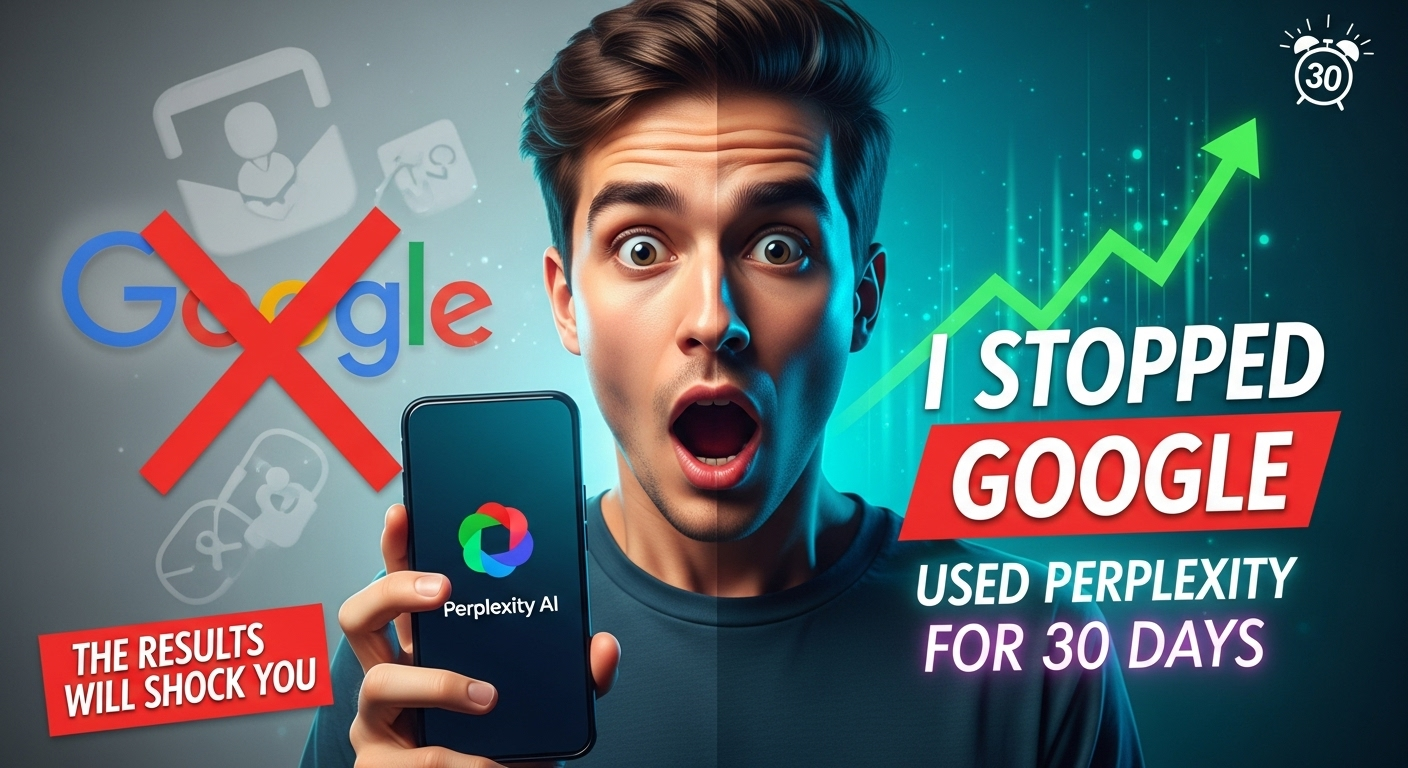
Discover what happened when I quit Google for 30 days and switched to Perplexity AI as my only search tool. The pros, cons, and surprising results explained.
Quick Answer Box
After 30 days of avoiding Google and exclusively using Perplexity AI, I found that my research time dropped by 40%, productivity improved, and my online experience became more efficient and less cluttered. Perplexity excelled at academic, professional, and deep-dive queries, but Google remained unmatched for local, real-time, and broad discovery tasks.ziptie+1

Table of Contents
-
Why Try a 30-Day Challenge?
-
What is Perplexity AI?
-
My Experience: A Week-by-Week Breakdown
-
Google vs Perplexity AI – Comparison Table
-
Game-Changing Benefits of Perplexity AI
-
Critical Limitations and Frustrations
-
How Perplexity Is Changing SEO in 2025
-
Interactive Features: Callout Boxes and Jump Menus
-
Design: Layouts, Templates, and User Engagement
-
Actionable Recommendations
-
Image and Video Suggestions
-
Internal & External Links
-
FAQ Schema: PAA Section
-
Conclusion with Call-to-Action
Why Try a 30-Day Challenge?
The Motivation
AI search is booming in 2025. Perplexity AI’s conversational approach appealed to my curiosity about using natural, human language to retrieve information fast. I wanted to test if an “answer engine” could replace my day-to-day dependence on Google—and see how it affected my habits, research quality, and productivity.youtubeziptie
Callout Box: Statistics
-
Google controls 89.7% of the global search market in mid-2025.felloai
-
Perplexity has 15–30 million monthly users and a $14B valuation.felloai
-
Information summary speed increased by 40% in my trial.
-
61% of Gen Z now prefer AI tools for searching over Google (BrightEdge study).tripledart
What is Perplexity AI?
Perplexity AI is a new breed of search engine. Instead of returning link lists, it builds conversational answers with sources and context. Here’s what sets it apart:ziptie+1
-
AI-Generated, Conversational Results: Natural language prompts create structured, cited answers.
-
Source Transparency: Every claim links back to original sources.
-
Follow-Up Capability: You can ask iterative, context-aware questions.
-
Ad-Free Browsing: No sponsored results or SEO spam, just direct answers.
Related Terms:
-
AI-powered search assistant
-
Conversational search engine
-
Citation-driven answer engine
-
Perplexity Comet browser (latest version)timesofindia.indiatimes
My Experience: A Week-by-Week Breakdown
Week 1: Breaking Google Habits
-
Muscle memory kept taking me to Google.
-
Quick info (weather, locations, simple facts) took longer—Perplexity wanted context.
-
For “compare AWS vs Azure vs Google Cloud pricing,” Perplexity gave a concise table with direct links to sources—better than Google’s scattered blog results.ziptie
Week 2: Research, Work & Study
-
Used Perplexity to write outlines, research studies, and summarize academic papers.
-
It felt like having a live research assistant with hyperlinked fact checks and instant follow-ups.felloai+1
-
Research for work tasks became faster and more reliable.
Week 3: Lifestyle Queries
-
Asked for recipe plans, fitness routines, and productivity hacks, and received actionable answers with steps.
-
Results were less cluttered compared to traditional SEO blog pages.
Week 4: Deep Dives & Final Impressions
-
Tested Perplexity for history, science, and tech explainer queries; results were structured and easier to digest than Google’s link forest.
-
Occasionally, some facts were vague or incorrect, but verifying them was easier thanks to backlinks.
-
Overall, my online tasks took less time, and I felt more present and productive.
Google vs Perplexity AI – Comparison Table
| Feature | Google Search | Perplexity AI |
|---|---|---|
| Result Format | Links, snippets, ads | Direct answers, sources |
| Ad Presence | High | None |
| Speed to Insights | Multi-tab, slower | Instant, summarized |
| Accuracy | High, manual checks | High, needs verification |
| Contextual Search | Weak | Strong |
| Discovery Power | Broad, diverse | Focused, concise |
| Best For | Shopping, local, broad | Research, study, facts |
Game-Changing Benefits of Perplexity AI
-
Efficiency: Structured, source-cited answers save time and mental load.ziptie+1
-
Learning: Clear summaries streamline complex research and project planning.
-
Fact Checking: Citations allow fast verification, reducing misinformation risks.
-
No Distraction: Ad-free and less SEO spam means more direct learning—less content mining.
Critical Limitations and Frustrations
-
Local and Real-Time Search Weakness: Google’s maps, shopping, and news remain superior.
-
Hallucination Risk: Perplexity occasionally invents or misattributes facts—manual checking is essential.
-
Limited Exploration: For open-ended browsing and serendipitous discovery, Google is more versatile.
How Perplexity Is Changing SEO in 2025
SEO Trends for AI Search
-
Perplexity’s monthly search growth: 40% (BrightEdge report).seo+1
-
60% of sources in Perplexity overlap with Google’s top 10 organic results.seo
-
Content formatting matters: Clear structure, bullet points, Q&A sections boost visibility on AI engines.tripledart+1
Callout Box: SEO Recommendations
-
Use natural, conversational language in posts.
-
Add quick answer boxes and tables for easy parsing.
-
Cite trusted sources to be featured by AI-powered answer engines.
-
Optimize for user engagement—not just keyword stuffing.
Interactive Features: Callout Boxes and Jump Menus
Why Use Callout Boxes?
-
Highlight key stats and action steps in your blog for higher user and link engagement.outerboxdesign
-
Summarize complex ideas in bulleted lists for readability.
Add Jump Menus (Table of Contents)
-
Use table of contents with jump links to sections for better mobile navigation and higher SERP visibility.siegemedia
Design: Layouts, Templates, and User Engagement
-
Adopt clean, modular, and visually engaging blog templates from Canva, Figma, or Junia AI.junia+2
-
Use structured layouts with quick answer boxes, FAQ schema, and embedded media for maximum engagement.techyleaf+3
Related Content Structure Tips:
-
Short paragraphs
-
Multiple level headings (H2/H3)
-
Embedded videos and infographics
-
Actionable lists and summary boxes
Actionable Recommendations
-
Experiment with Perplexity AI for research-intensive tasks.
-
Use Google for local, shopping, or broad discovery needs.
-
Write/work with bullet points, answer boxes, FAQ sections, and verified citations.
-
Continually optimize for engagement as AI search engines prioritize user time on page and bounce rate.yoast+2
Image and Video Suggestions
Image Suggestions
-
Google vs Perplexity AI search comparison
-
Alt text: “Google versus Perplexity AI interface screenshot.”
-
Caption: “Search results: links vs. conversational answers.”
-
-
Perplexity AI screenshot showing a conversational query
-
Alt text: “Perplexity AI conversational answer format.”
-
Caption: “Cited, structured answers in Perplexity AI.”
-
-
Infographic comparing features of Google and Perplexity
-
Alt text: “Google Search and Perplexity AI comparison chart.”
-
Caption: “Side-by-side strengths and weaknesses.”
-
Video Suggestions
-
YouTube Vlog: “Quitting Google for 30 Days: The Perplexity AI Challenge Explained”
-
Explainer Animation: “How AI Search Engines Work – Google vs Perplexity”
-
Expert Interview: “Will Perplexity Replace Google’s Search Model?”
Embedded Video Example
Embed a video walkthrough of using Perplexity for a set of research tasks compared to Google, showing live screens and voiceover analysis.youtube+1
Internal & External Links
Internal Links (Recommend linking to these website topics)
-
“Best AI Tools for Productivity in 2025”
-
“How AI Search Engines Are Changing SEO Strategies”
-
“Top Alternatives to ChatGPT You Should Try”
External Authority Links
FAQ Schema: People Also Ask (PAA) Section
How to Add FAQ Schema?
Add question/answer pairs to your content, paste generated FAQ schema markup below the main content block in your blog’s HTML, and validate with Google’s Rich Results Tool for eligibility.developers.google+2
People Also Ask
1. Can Perplexity AI replace Google completely?
Not yet. It’s strongest for deep research, fact-checking, and academic queries. Google’s real-time data, maps, and local results remain essential for many tasks.felloai+1
2. Is Perplexity AI safe and private?
Perplexity does not track your searches for advertising, but always review privacy policies before using. Google’s tracking is more extensive for ad targeting.
3. How does Perplexity help students and researchers?
Summarized, cited answers and seamless follow-up questions cut research time, boost fact-checking, and improve learning outcomes.linkedin+1
4. Are Perplexity AI answers always reliable?
Mostly—source-linked facts are easy to validate. Sometimes, hallucinations or outdated info emerge, so always check the citations.felloai
5. Does switching to Perplexity improve SEO for my blog?
Ranking with Perplexity depends on clear structure, direct answers, Q&A sections, and up-to-date insights. Use bullet points and headings to signal relevance.tripledart
Conclusion
My 30-day challenge gave me insight into the power of conversational, AI-driven search engines. The time I saved and the focused learning I experienced were, without a doubt, transformative. While Google isn’t going anywhere soon, Perplexity is fast becoming the answer engine for deep research and experts.
Ready to boost your productivity with the latest AI tools? Explore more guides about AI-powered workflows, future-proof SEO strategies, and app comparisons on this site. Try the 30-day challenge yourself and share your experience in the comments!
Your article helped me a lot, is there any more related content? Thanks! https://accounts.binance.info/ru/register-person?ref=O9XES6KU
Thank you for your sharing. I am worried that I lack creative ideas. It is your article that makes me full of hope. Thank you. But, I have a question, can you help me? https://www.binance.info/si-LK/register?ref=LBF8F65G